Airline Performance Analytics: From Flights to Insights
Turning Operational Data into Strategic Airline Decisions
Executive Summary
In the competitive airline industry, data-driven performance management
has become a strategic advantage. This project was developed to provide a
unified analytics platform that empowers executives and analysts to monitor
operational efficiency, profitability, and customer behavior in real time.
Through a robust SQL-based data architecture and advanced analytical models,
Airline Performance Analytics delivers clear, actionable insights that
support strategic, financial, and operational decision-making.
Business Problem
Airlines face constant challenges balancing profitability, efficiency, and customer satisfaction. Key decision-makers need accurate and accessible insights to answer questions such as:
- Which routes and aircraft generate the highest margins?
- How do delays and cancellations affect revenue and brand perception?
- What passenger segments drive profitability and loyalty?
However, fragmented systems and siloed data often make it difficult to:
- Consolidate flight, booking, and passenger information into a single source of truth.
- Identify underperforming routes and low-margin operations.
- Track the financial impact of disruptions and operational inefficiencies.
The solution: a centralized, analytics-ready data system that integrates all operational data streams, enforces quality and consistency, and provides executive-ready KPIs for strategic decision-making.
Solution Overview
The initiative was structured around three complementary modules
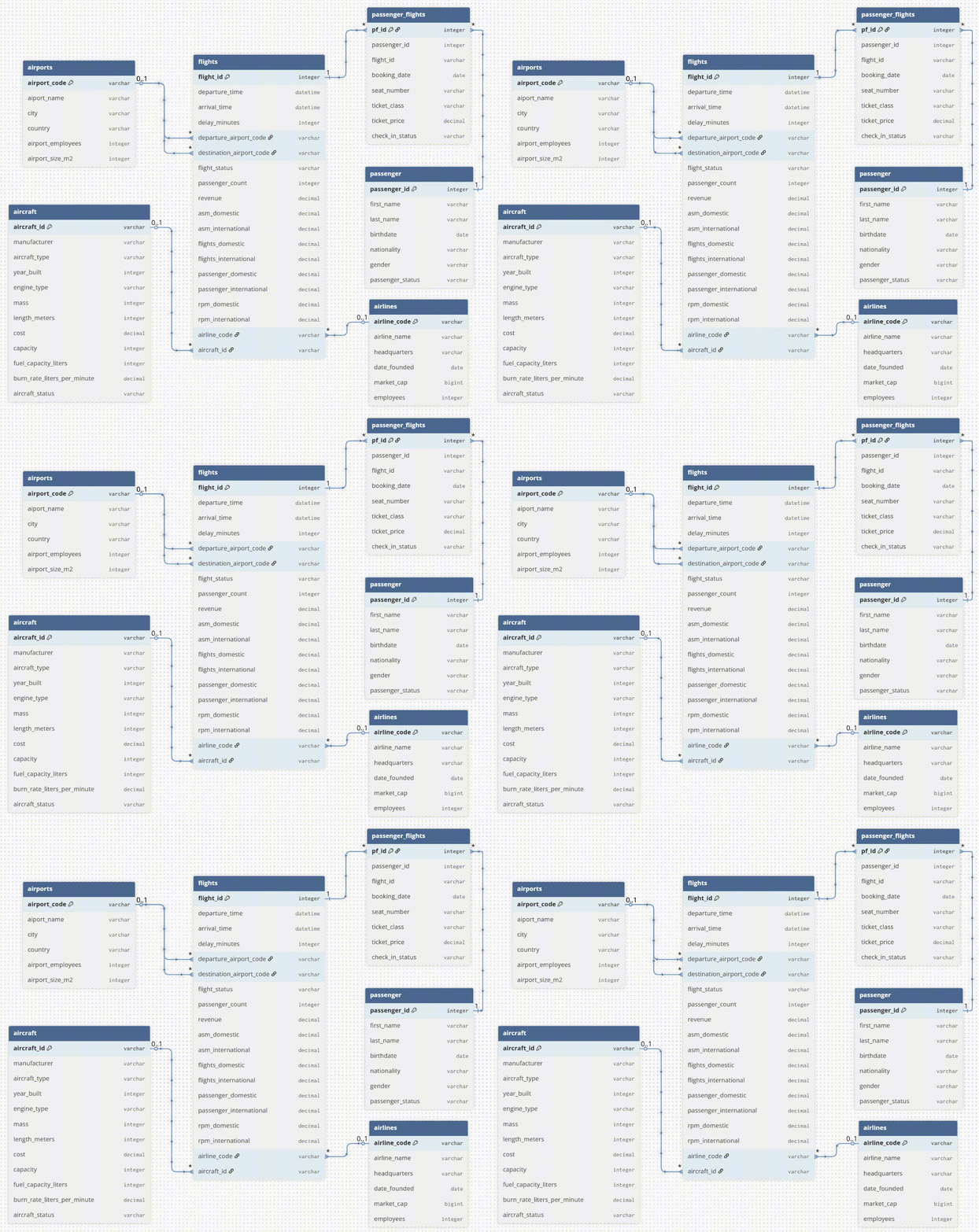
- Revenge of the Seat (Data Warehouse)
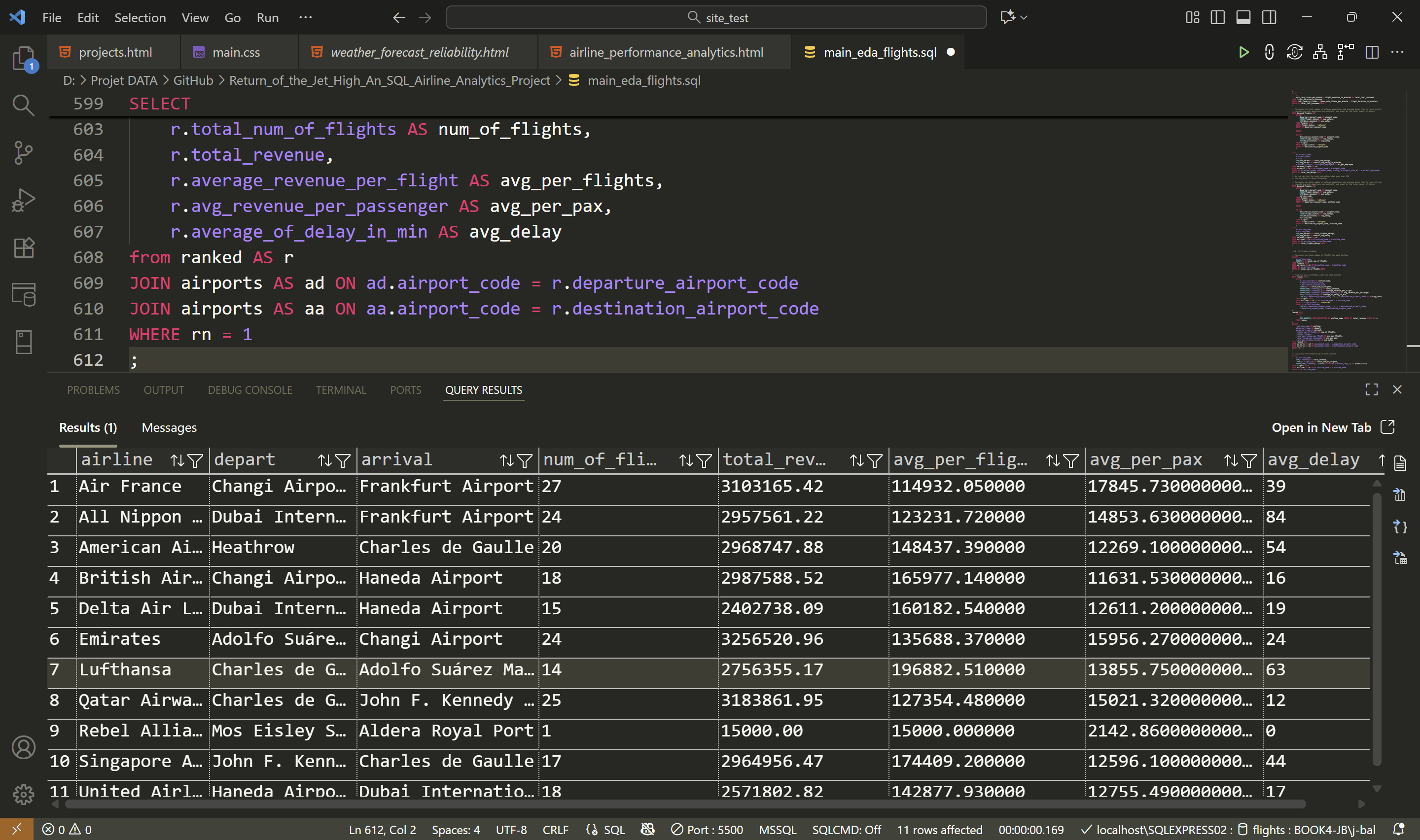
- Return of the Jet High (Analytics Engine) and
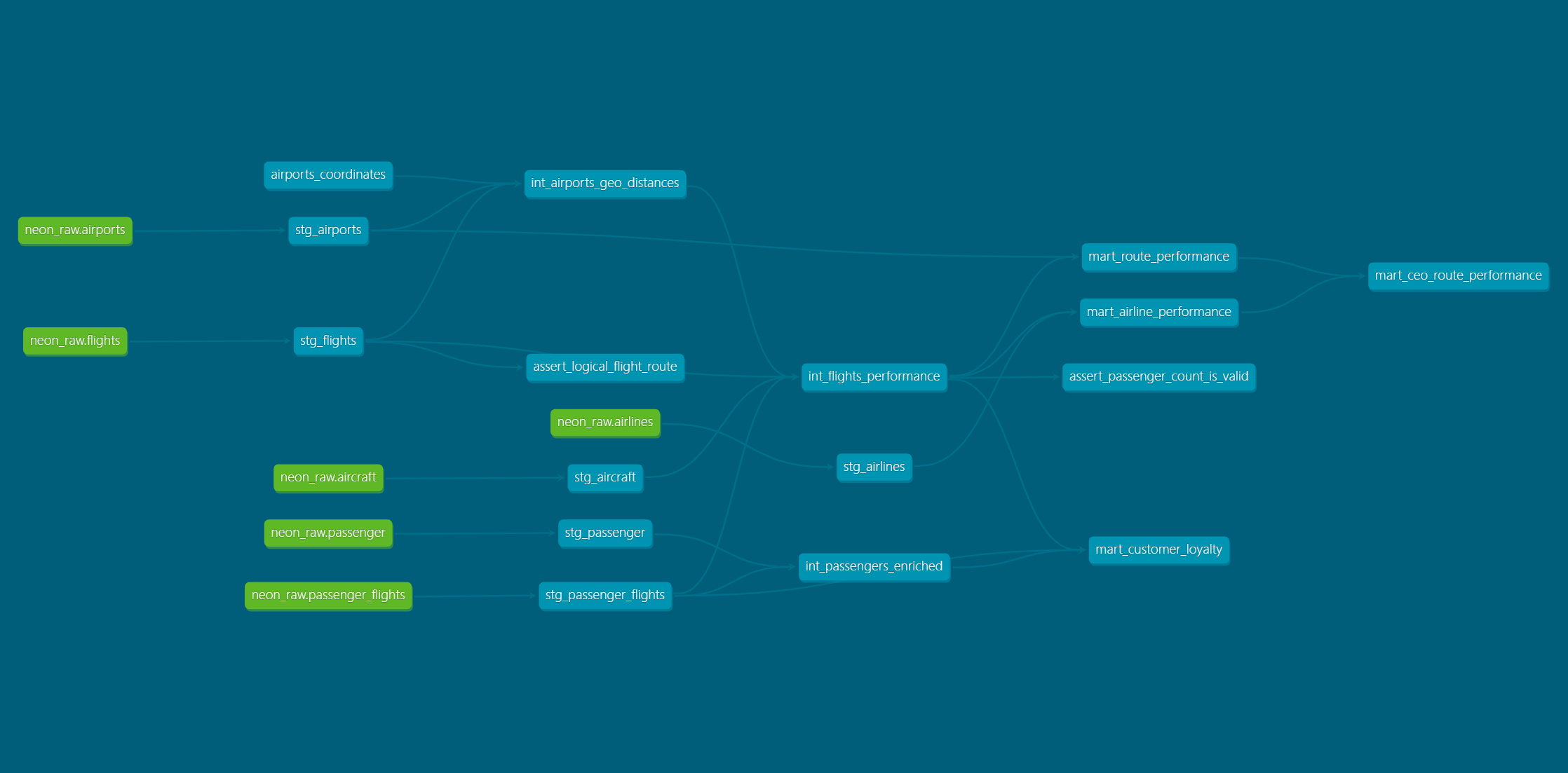
- The Rise of the Single Source (Analytics Engineering)
each delivering a specific layer of business value and forming a
complete airline intelligence ecosystem.
Together, they deliver a robust end-to-end architecture that consolidates
operational data and transforms it into business-ready insights for
strategic decision-making.
| Module | Description | Business Value |
|---|---|---|
Revenge of the Seat (Data Warehouse) | A fully normalized relational data warehouse designed with Merise methodology, integrating flights, aircraft, passengers, and bookings under strict referential integrity. | Establishes a single source of truth for all operational and financial data, enabling accurate reporting, compliance, and cross-departmental alignment. |
| Return of the Jet High (Analytics Engine) | A SQL-based analytics layer delivering KPIs on route profitability, fleet utilization, delay performance, and customer segmentation. | Converts raw operational metrics into actionable insights that drive pricing, scheduling, and strategic optimization decisions. |
The Rise of the Single Source (Analytics Engineering) | A modern transformation layer using dbt, automating complex data modeling while enforcing rigorous data quality tests and documentation. | Ensures data reliability and certification. It provides a scalable framework to industrialize KPIs and guarantee that executives work with trusted, verified data. |
By combining these modules, the platform bridges the gap between data operations
and business strategy, empowering executives to monitor performance, identify
opportunities, and make faster, evidence-based decisions.
The result is an end-to-end data ecosystem that transforms flight data
into strategic intelligence, ensuring decision-makers have the
insights they need, when they need them.
Business Impact
- 360° visibility : into airline operations, financial performance, and customer segments.
- Profitability insights : by route, fleet, and market, enabling data-driven pricing adjustments.
- Delay analytics : quantifying the direct and indirect cost of disruptions.
- Customer intelligence : models supporting retention, loyalty, and premium targeting.
- Executive-ready dashboards : aligned with operational and financial KPIs.
- Data Trust & Certification : 60+ automated quality tests ensuring the accuracy of financial and operational reporting.
The platform enables leadership teams to:
- Prioritize high-margin routes and streamline underperforming ones.
- Anticipate operational risks impacting punctuality and service quality.
- Reinforce data-driven pricing and capacity planning strategies.
Key Insights
The following analysis compares major international carriers based on
aggregated KPIs computed within the Analytics Engine.
Each indicator helps assess both operational efficiency and
financial performance, providing an overview of revenue generation,
delay management, and reliability.
| Airline Name | Total Flights | Total Passenger | Total Revenue | Avg. Revenue per Flight (€) | Avg. Revenue per Passenger (€) | Avg. Delay (min) | On-Time Rate (%) | Cancellation Rate (%) |
|---|---|---|---|---|---|---|---|---|
| Air France | 2,556 | 529,002 | 328M | 134,261.63 | 620.55 | 36.97 | 71.25 | 4.34 |
| All Nippon Airways | 2,503 | 510,151 | 322M | 134,489.43 | 632.44 | 35.88 | 69.95 | 4.16 |
| American Airlines | 2,505 | 501,859 | 315M | 132,274.81 | 628.88 | 36.70 | 70.54 | 4.75 |
| British Airways | 2,354 | 485,613 | 304M | 135,445.22 | 626.72 | 41.78 | 67.20 | 4.55 |
| Delta Air Lines | 2,475 | 507,290 | 326M | 137,979.24 | 643.26 | 34.91 | 71.21 | 4.44 |
| Emirates | 2,466 | 499,900 | 321M | 135,602.87 | 642.89 | 38.38 | 69.54 | 3.89 |
| Lufthansa | 2,506 | 507,665 | 319M | 133,105.63 | 629.26 | 35.75 | 70.63 | 4.23 |
| Qatar Airways | 2,571 | 520,505 | 324M | 132,672.56 | 623.21 | 34.91 | 69.90 | 4.90 |
| Singapore Airlines | 2,523 | 514,213 | 327M | 137,167.32 | 636.20 | 37.23 | 70.23 | 5.47 |
| United Airlines | 2,541 | 525,440 | 324M | 133,871.03 | 618.35 | 38.77 | 70.17 | 4.49 |
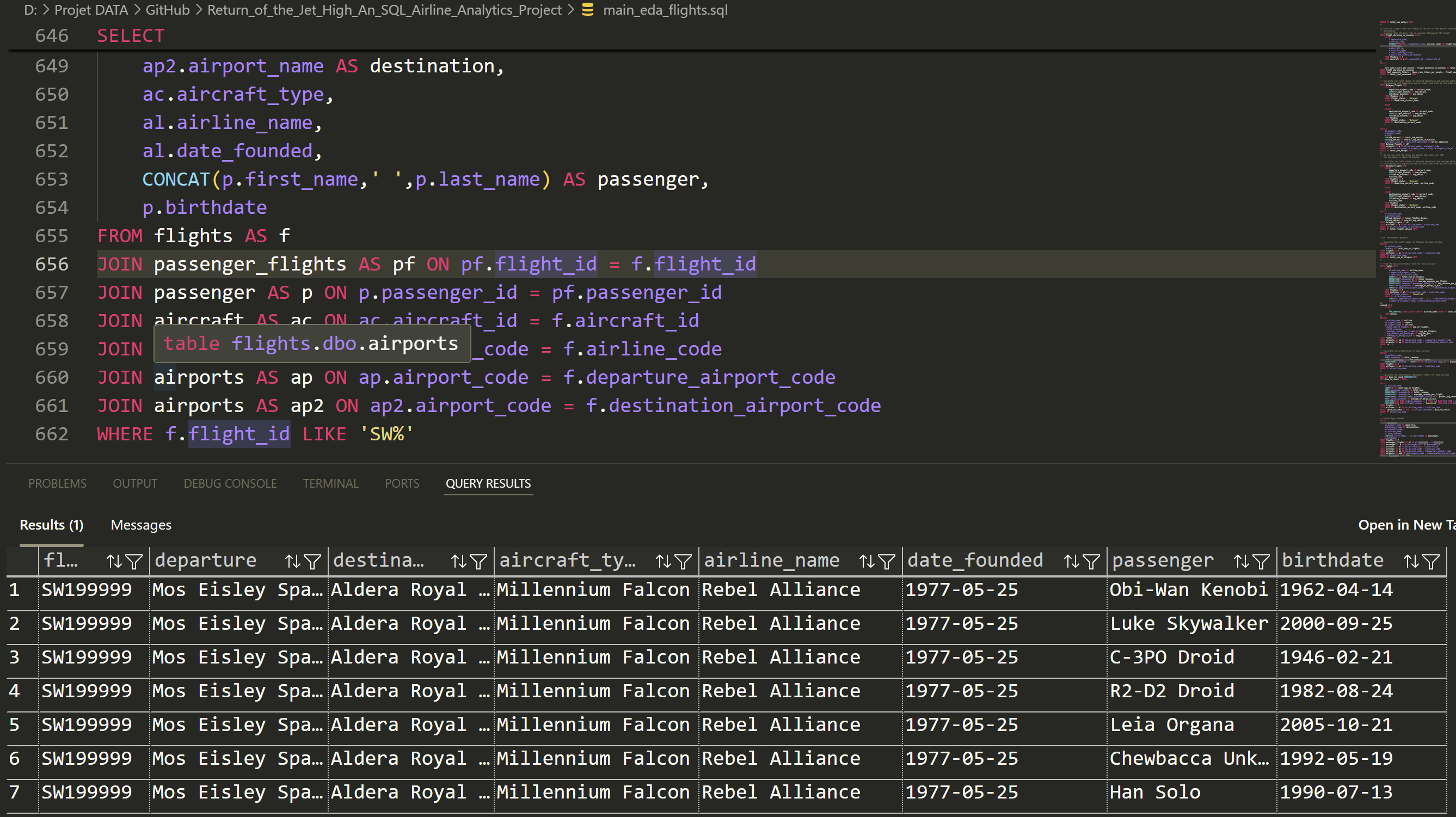
| Rebel Alliance | 1 | 7 | 15,000.00 | 15,000.00 | 2,142.86 | 0.00 | 100.00 | 0.00 |
- Delta Air Lines records the highest average revenue per flight (€137,979), indicating strong performance on high-yield routes.
- Air France leads in total revenue and passenger volume, confirming its position as a major European hub carrier.
- Air France shows the highest on-time rate (71.25%), while British Airways — despite good delay management — reports slightly lower route profitability compared to Delta.
- The global cancellation rate remains below 5%, indicating strong network stability across almost all carriers.
- Overall, airlines achieving a better balance between delay control and passenger yield (notably Delta and Air France) outperform peers in financial efficiency.
These insights support executive decision-making in areas such as route optimization, fleet deployment, and pricing strategy — demonstrating how the platform transforms operational data into strategic intelligence at scale.
Technologies Used



What’s Next
- Integration of real-time data ingestion pipelines for continuous KPI updates and near real-time operational monitoring.
- Development of predictive analytics models for demand forecasting, delay prediction, and disruption management.
- Deployment of Power BI executive dashboards consolidating financial, operational, and customer insights for data-driven decision-making.
- Expansion of the analytical framework to multi-airline alliances and partner networks for cross-company benchmarking.
- Implementation of DCL (Data Control Language) and TCL (Transaction Control Language) features to strengthen data governance, access control, and transactional consistency in future system iterations.
Summary
Airline Performance Analytics demonstrates how operational data can be
leveraged to drive strategic and financial impact.
By combining strong data governance, advanced SQL analytics, and
modern Analytics Engineering, the platform empowers airlines to:
- Optimize revenue and operational performance.
- Anticipate risks and inefficiencies.
- Make informed, data-backed decisions based on a certified Single Source of Truth.
Because in aviation, just like in data, performance isn’t only about flying, it’s about knowing where and how to soar.
Gallery